Millions of Youth Seeking Belonging: How the Affordability Crisis Impacts Summer OST Program
August 17, 2026
For over 25 years, the Forum for Youth Investment has been a leading advocate for out-of-school (OST) programming, developing and optimizing how OST providers cultivate communities of care and transformation. These settings have been found to increase the likelihood a young person will transition smoothly into college and career, yet many youth are still excluded from these experiences each year, especially when the school year ends. While youth enrolled in summer camps and citywide employment programs get exposure to new tools and people, develop critical life skills, and cultivate a community of prosocial peers and adults, millions of their classmates can only afford to peer in through the window.
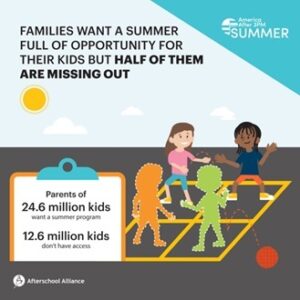
The Afterschool Alliance released the report, The Summer Struggle for Everyday Families: Affording the Opportunities Parents Want for Youth, commissioned by The Wallace Foundation. The findings amplify a hard reality: when we price families out of summer enrichment, we deprive youth of vital experiences that shape and protect their mental health. The report details a research study finding that 24.6 million parents desire high-quality summer programming for their children, but nearly half of them cannot attain it due to cost constraints. This means we are leaving 4 in 10 young people on the cliff of an access and affordability gap at the start of each summer, no doubt compounding the frustration and disappointment of cost-related barriers they faced throughout the school year.
These youth are missing opportunities to strengthen their protective factors and experience more belonging. Belonging is regularly cited by youth as a critical component of their mental health. Belonging empowers them to navigate extreme stress or sadness in meaningful ways with peers and adults who make them feel safe and valued. Because participating in high-quality OST experiences fosters a greater sense of belonging, ensuring access to summer programming is a critical strategy for improving youth mental health trends across the nation.
Deep Investments Can Dissolve Inequality
The report rounds out its findings with guidance for stakeholders committed to expanding access to summer OST programming:
- Increase public and private investments in summer learning programming at the national, state, and local levels;
- Reduce barriers to participation by creating resources for families that provide information on summer learning options or through grants that alleviate specific challenges like transportation;
- Design summer learning opportunities that align with parents’ and young people’s priorities and needs; and,
- Reduce state and local administrative barriers to providing snacks and meals during summer learning programming.
In alignment with these recommendations, the Forum continues working to close the access and affordability gap by protecting crucial funding streams, such as WIOA (Workforce Innovation and Opportunity Act), as a leader of the Reconnecting Youth Campaign. WIOA dollars often land directly into the hands of young people who need extra support to participate in youth programming while they are out of school. In some cases, WIOA funds also enable community-based organizations to completely subsidize enrollment, eliminating the barrier of cost completely.
As active partners of the Afterschool Alliance, we also advocate strongly for the 21st Century Community Learning Centers (CCLC) Act. CCLC funds enable OST programs to integrate family literacy and other engagement activities into their program model. These program models also drive the field toward accomplishing another takeaway from the Wallace report: parents and young people desire robust programming that meet a variety of needs, especially academic support while school is out for the summer.
The Mental Cost of Being Excluded
A recent study from the Afterschool Alliance found that low-income families are less likely to enroll their children in OST programming, despite equal desire to high-income families, due to cost and ease of access. Data from the National Institutes for Health also reveals alarming disparities in mental health care, with low-income children being at higher risk for mental health challenges and among the least likely to be enrolled in mental health care.
Therefore, the Forum is ramping up focus on youth mental health as an equity lever. This includes joining the upcoming cohort of the Institute for Youth Mental Health. Through the IYMH the Forum will expand our capacity as advocates for youth wellbeing with guidance from partners at The Jed Foundation and America’s Promise Alliance. This investment is critical, as our nation’s mental health crisis continues to manifest at the intersection of affordability and accessibility.
Partner with Us Today!
The report is a reminder that there is still much to be done in the OST field in order to ensure every youth is ready for school, work, and life. We are proud to anchor our work in the shared awareness that closing the access and affordability gaps for summer program is not only a matter of economics, but equity. The Forum for Youth Investment is committed to investing in what works, partnering with peer organizations, policymakers, and advocates who believe all youth deserve belonging and community, especially during the summer months. Together, let’s ensure all youth have access to high-quality summer programming.
You can partner with us and learn about other ways we are innovating the youth development field, by signing up for our newsletters and connecting with us on LinkedIn.
Together we can ensure all youth are ready for school, work, and beyond.